Comparisons & Decision Guides
Multi-Generational Fire Pit Comparison: Family-Safe Heat
29th May•12 min read
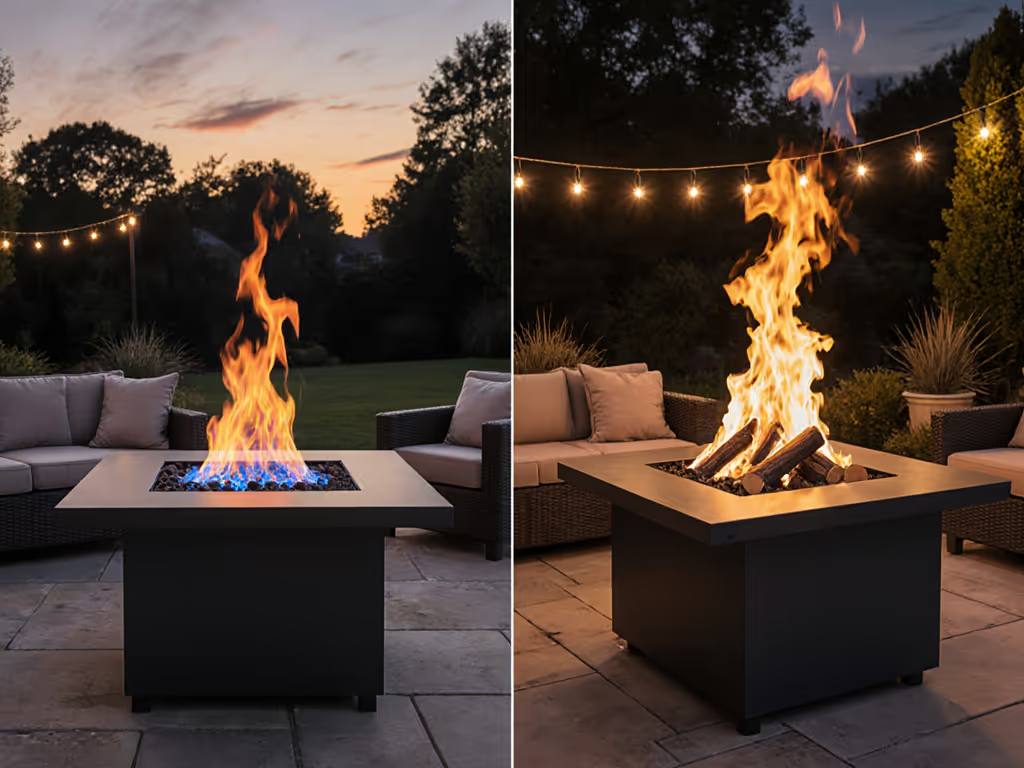
When you're choosing fire pit media for different fuel types, you're making a choice that affects more than just your comfort (it affects how your courtyard feels to everyone nearby). Heat performance matters, but so does what is happening in the air around it. Let me walk through the physics and practicalities of gas versus wood, a fire pit media aesthetic comparison, grounded in real data and a clear-eyed look at neighbor harmony.
Neighbors breathe your choices. That principle shapes everything I test, and it should shape your decision too.
Fire pit media (the glass beads, rocks, logs, or briquettes that sit beneath or around your flame) aren't just decoration. They are thermal actors in your heating performance. For a step-by-step selection checklist, see our safety-first media selection guide.
With wood-burning fire pits, the media are the fuel: hardwood logs radiate intense heat as they combust. With gas fire pit setups, media are passive; they sit around the burner and reflect or absorb heat, changing how warmth feels to guests and where it travels.
The choice of media type influences:
Understand the media, and you understand why a beautifully designed gas fire pit often outperforms a roaring wood fire in usable, neighborhood-friendly heat. For measured warmth radius and intensity gradients, explore our fire pit heat patterns data.
Wood fires win on peak temperature and raw BTU output. Hardwood logs (oak, hickory, maple) burn at 1,600°F to 2,000°F, while propane ranges from 1,200°F to 1,800°F, and natural gas sits lower at 900°F to 1,500°F[5]. For installation and cost trade-offs between fuel types, see our propane vs natural gas comparison. A well-loaded wood-burning fire pit can produce between 5 to 18 kW of thermal energy per hour, depending on wood quality and fireplace design[1].
Gas fireplaces, by contrast, typically deliver 4 to 11 kW per hour with much more predictability[1].
But here's the catch: raw output isn't usable warmth.
Efficiency is the hidden engine. Gas fireplaces operate at 60% to 90% efficiency (meaning 60 to 90 cents of every dollar of fuel energy stays in your space)[1]. Open wood fires? A mere 10% to 30%[1]. Most of that radiant heat escapes straight up the chimney with the smoke and hot gases[1].
Even newer wood-burning fire pit inserts, which can reach 60% to 85% efficiency, still lose more energy than gas[1].